I’m still figuring out what my own personal AI environment should look like.
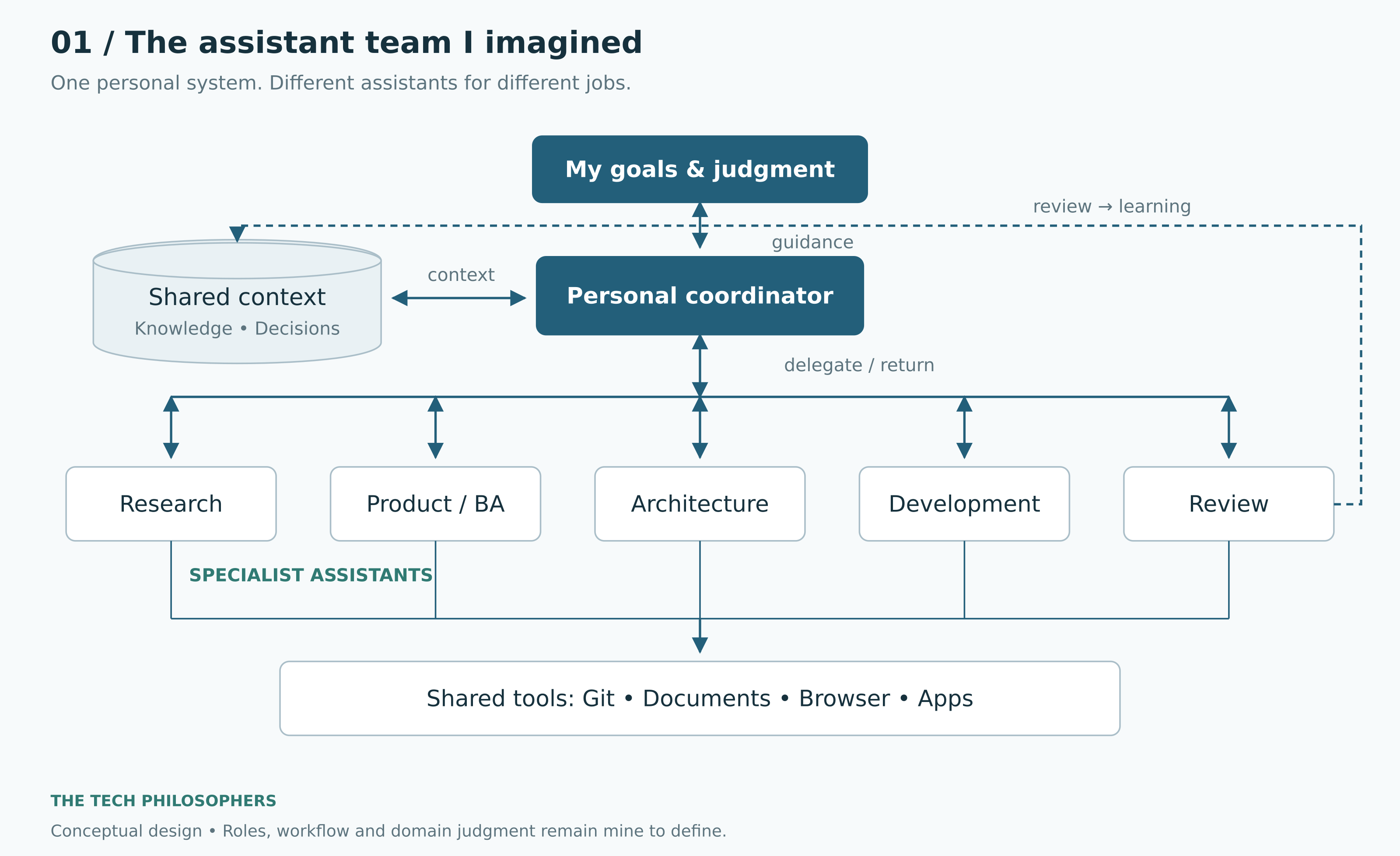
I started exploring an agentic setup on my MacBook because I wanted assistants that could understand my way of working. I wanted help with research, thinking through requirements, designing solutions and carrying work forward. I began looking at roles, instructions, context and how these assistants could work together.
As an architect, I was thinking about how to build this setup. As a user, I was thinking about what I wanted it to do for me.
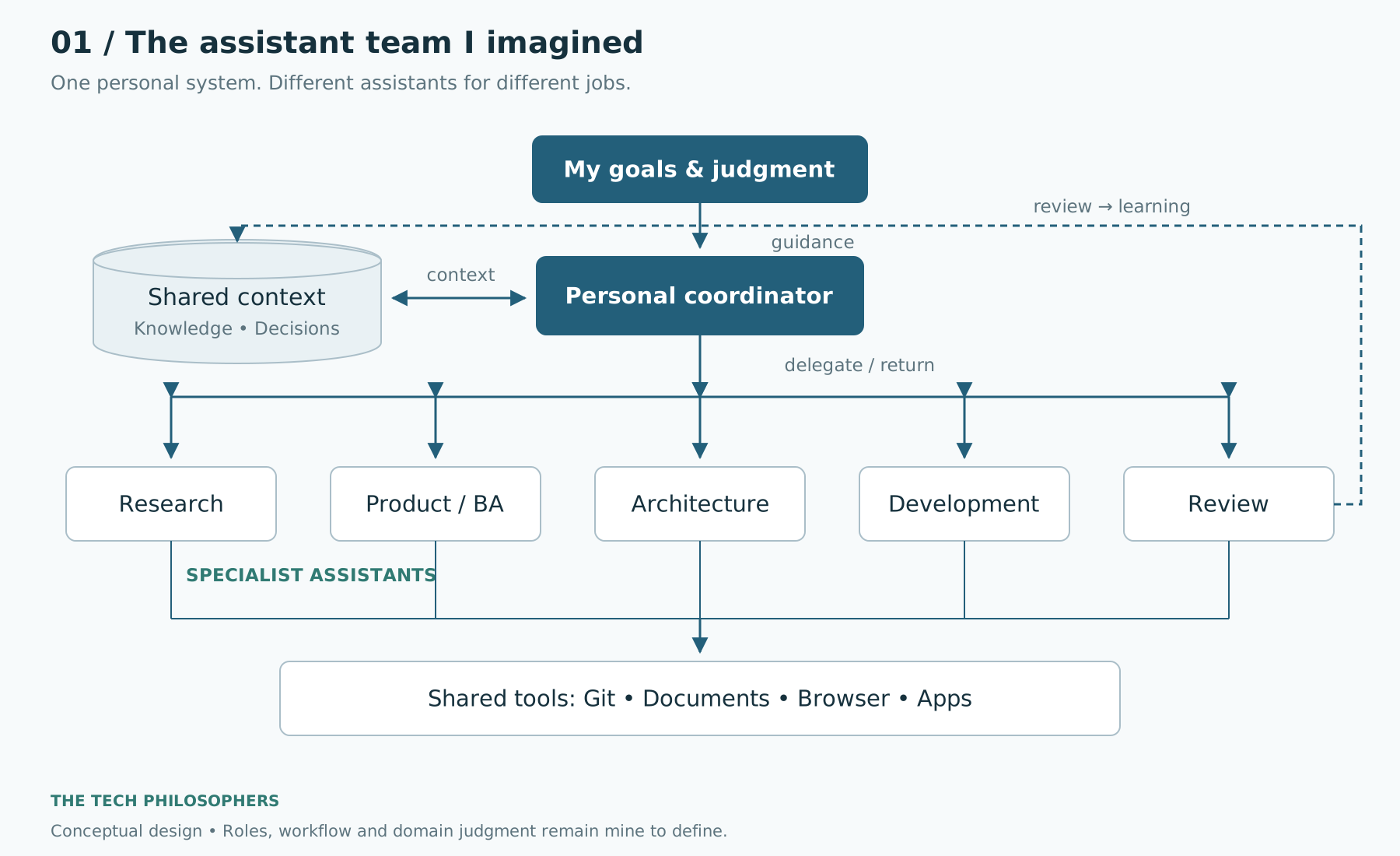
Download diagram: the assistant team I imagined (PNG)
But something interesting keeps happening: while I’m exploring what to build, the platforms themselves are introducing capabilities that overlap with my plans.
The environment around my idea is changing
Apple is developing the on-device side of AI through its silicon and software. Its Neural Engine is part of that hardware foundation. Apple Intelligence also uses Private Cloud Compute for requests that need more capacity, so this is not simply a story of everything moving onto the device. Apple’s explanation
Perplexity’s Personal Computer is another development I’m following: an agent product designed to work with files and applications on a Mac. It brings the idea of a personal assistant closer to the environment where work actually happens. Perplexity Personal Computer
The recent conversation between Satya Nadella and Jensen Huang connects with this too. They discussed agents on our computers becoming personal assistants. Microsoft’s MXC addresses execution boundaries for agents, one part of the wider local-and-cloud direction. NVIDIA’s account of the discussion
These are different pieces, not interchangeable solutions. Hardware that runs AI, an assistant that uses applications, and controls around what an agent can access each address different needs.
For me, they make the architectural question more interesting.
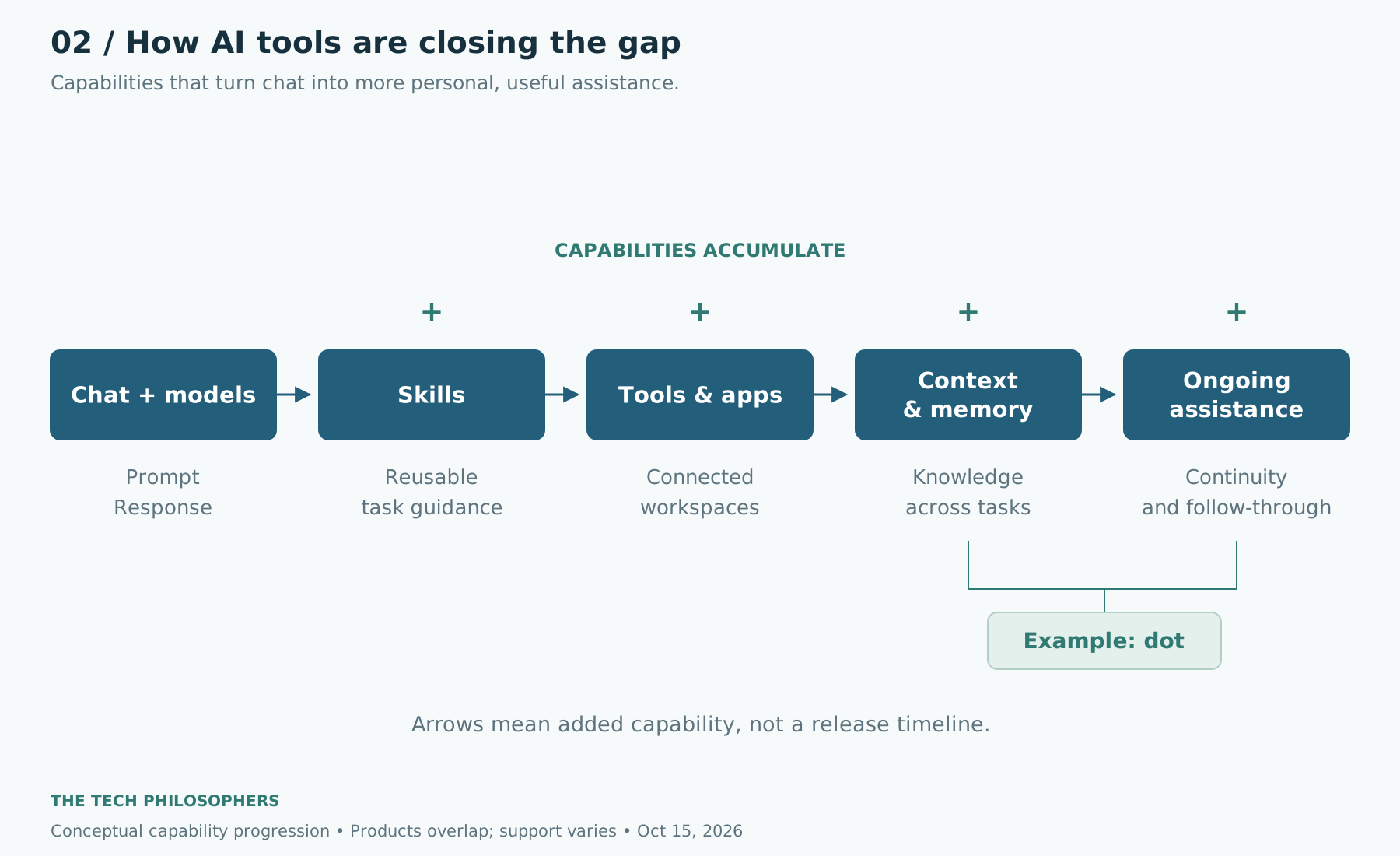
Download diagram: how AI tools are closing the gap (PNG)
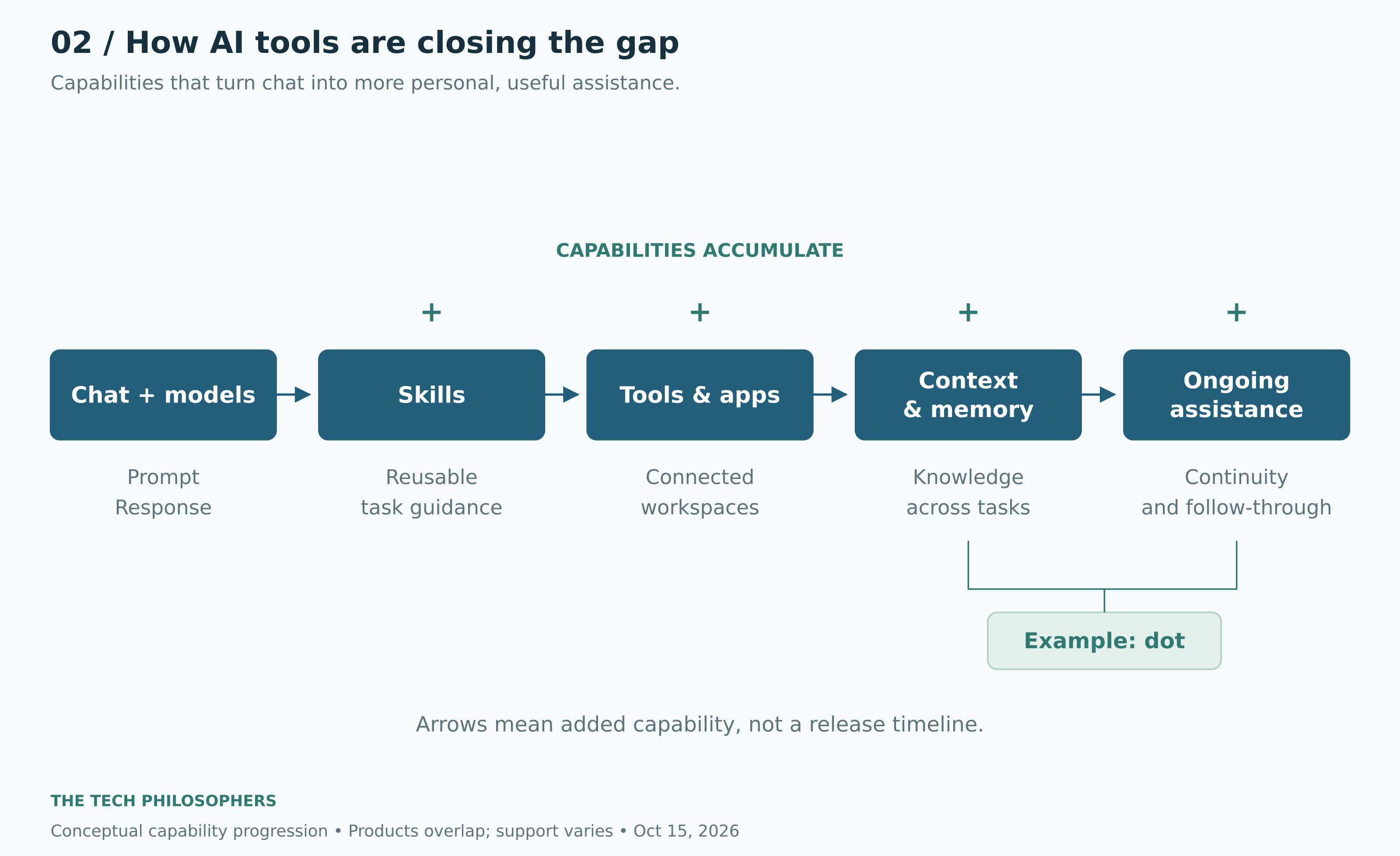
Diagram reference: Getting started with your dot.
What should I build, and what should I build upon?
My experience with dot is part of this exploration. It gives me a way to work with an assistant and understand what I need through actual use. It hasn’t settled every question about my own environment.
I still want a setup that reflects my intentions and working style. I also want to adopt better capabilities as they become available, without having to start again every time the technology changes.
That means I’m continually asking which parts deserve my own design effort and which parts a platform can provide. I don’t have a final answer yet.
Learning cannot stop at today’s answer
What stands out in my own use of AI is the speed of turnaround. I can explain an idea, see a result, clarify the direction and iterate quickly. That gives me a practical way to learn, even when the first result needs correction.
At the same time, I’m careful about treating today’s experience as a permanent conclusion. A capability I’m waiting for may arrive. A limitation I encounter may improve. An approach I’m considering may need to change.
These developments don’t make my exploration pointless. They give me more to work with and more to think about.
I’m still searching for the right architecture for my personal AI environment. The goal is to keep learning and building, while staying open to a better way of reaching it.